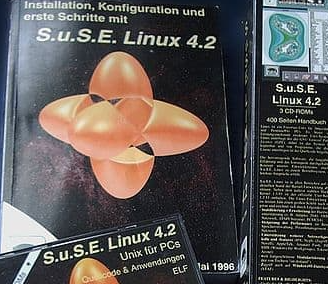
Look at @myswtest 's post above. This never was the correct spelling. It was SuSE.
Here we go again. Is my conclusion that people who are sloppy in simply copying correct texts are likewise sloppy in maintaining their systems correct? I hope not. 
Look at @myswtest 's post above. This never was the correct spelling. It was SuSE.
Here we go again. Is my conclusion that people who are sloppy in simply copying correct texts are likewise sloppy in maintaining their systems correct? I hope not.
Please read the link and you will see the hystory of S.u.S.e till openSUSE
SUSE LINUX 9.2, 9.3, 10 and then onto SLED and a bit of openSUSE, 10.0 wasn’t that good for me but persevered on a not critical machine. I then did a flip flop between releases, one release SLED and then one release openSUSE as a primary system. Now it’s Tumbleweed and Leap…
I still run SLES on a RPi3…  just to keep up with changes there…
I was also a SUSE Knowledge Partner for many years, so did get some perks with that 
And where do you see it written with lowercasee?
I see there
Der Name S.u.S.E. stand dabei als Akronym für Software-
und System-Entwicklung.
and
im Dezember 1998 wurde der Unternehmensname (Firma) von S.u.S.E. in SuSE geändert.
Which all have E as the last character. I am flabbergasted.
I wrote the Spanish wiki since 2007. Since then I always wrote the name as is: openSUSE. Even in the start of a paragraph if I can’t avoid start a paragraph that way 
You know: “openSUSE is a wonderful project that…”
And is fine for me. The name is openSUSE and while we don’t change it, it will be the same. And wiki is a sort of marketing or commercial stuff. In the same way, I use snapshots of the desktop following the default style, not my personal desktop. And you know, when I need post a snapshot, I use a VM because my desktop has changes etc.
In the theming and branding of this forum we had to use the right name “openSUSE”. Só a new user cand read “ahoy to openSUSE forums” etc. And there is right tones of green, a right font to type.
We (admins or moderators) should use *the formal way", openSUSE. And make some sense tells one user some as “hey, you know, the right way is openSUSE”. But that’s far from hounding users to see if they spell “openSUSE” correctly at all times. I post in my smartphone from time to time, so may I had wrote Opensuse some time 
The best way to show people the right way to write the name is to do so consistently. Berating people over forum posts isn’t terribly effective, in my experience. It’s not like people asking questions here are writing a book (where the spelling is important) or creating a legal document.
I tend to be much more relaxed about the capitalization when answering questions - to me, it’s not a question of clarity (I know what the person asking about is asking about if they write “openSUSE Tumbleweed” or “oPeNsUsE tUmbleWeed” or even gasp “openSUSE Thumbleweed” (which I see very frequently in the FB group and in the forums).
Is it correct? No. Is it important enough to raise a stink about in informal communications? Also no.
Just for interest: For English usage for formal writing, the Chicago Manual of Style says that at the start of a sentence, it would still be “openSUSE”. The AP Style is more strict, and requires that it be written “OpenSUSE”. The Microsoft Manual of Style (which is used in a lot of tech writing) has a requirement that the sentence be rewritten so the word isn’t the first word in the sentence (ie, “respect the brand identity” combined with “always capitalize the first word of a sentence”).
IBM’s style guide is similar to the Microsoft style guide. Their rule is “Do not start a sentence with a lowercase term; rewrite the sentence.”
I was a tech writer for years, so had to become familiar with many of the style guides out there. The bottom line is that there is no hard and fast rule about what is correct (speaking strictly from an English language usage perspective).
The bottom line for me is this:
We’re all human, and we all are going to make mistakes. Instead of feeling like it’s important to correct people when that’s not what they asked, we should just model the correct spelling/capitalization and leave it at that. Most people who don’t ask to be corrected do not appreciate the criticism. They came here (or wherever they’re asking for help) because they’re fans and they’re having a problem. Correcting someone’s spelling/usage doesn’t help them solve their problem, and it takes them from whatever level of frustration they’re having because they’re having a problem to that level plus some value, because now they’re also being told “you’re spelling it wrong, too!”
We need to be friendlier about it.
Sure. But that, in the start, wasn’t the point. It was about intentionally, knowingly writing openSUSE as OpenSUSE anyway, because one wants to. The “I write it the way I want” it. It’s fair to comment on that, right?
IME people don’t mind being corrected if you provide help at the same time. And most of them do not take it as criticism, certainly not with some explanation.
There certainly are ways to be kind about providing a correction, that is true.
But here’s the thing: In this context, it doesn’t really matter, and it isn’t worth a message on its own to say “hey, you spelled the name wrong.”
Like I said, we can be friendlier about it, and the best way IMHO to correct people is by providing an example, not by saying “do it this way”. That’s true not just for a spelling error (common or not), but just generally in life.
Too often, this becomes a subject of HUGE debate (as in this thread), and people really get bent out of shape about it. I would really love to see the energy that goes into correcting people’s “spelling mistakes” go into more important things in the project, like stepping up to help maintain infrastructure, contribute code, offer to test things out…basically to just be kind to our fellow users.
Asking a question in these forums, for help, is not generally an invitation to have someone provide a human spellcheck (or grammar correction) on the post. Sure, if things aren’t clear, ask clarifying questions (of course). I could not care any less if someone says “I’m using OpenSUSE Thumbleweed and I’m having this problem”. I know what they meant, and it was clear enough to make themselves understood.
All this bikeshedding on “spelling the name of the project correctly” is not particularly helpful to the real things the project needs help with, as you (of all people) know.
As I (of all people) know. Yes. But sometimes I call Sancho Panza, I mount Rucio and go fight some windmills.  . Not with new users, unless they show 3 different spellings in one post.
You must be really busy with that in the Netherlands. 
Here in Germany we only have the new generation, but they are everywhere; you’d need a flying dragon to get up there. 
Yeah, mountain slopes seem to be popular for growing them. And of course Ost Friesland.
Oh, oh, oh, wait, wait, wait: May I do this? Ah, whatever!
It’s spelled “Ostfriesland”!
Sorry, I just couldn’t resist!

I would like to know how worst is this name The best linux flavor name I like is gentoo. I spent two years in that distro on my spare machine and work on it in my spare time. Anyhow I learned much lesson from those couple of years, that’s why probably I am not encountering much problem in openSUSE Tumbleweed.
Besides the spelling problems we discussed here, when the name was adopted over 20 years ago, it was a decision made by Novell, the company that owned SUSE at the time. They wanted to do something similar, but more ambitious, to what Red Hat was doing with Fedora.
But Fedora is a good name: correctly spelled according to any orthographic standard, and it maintains the identity of the company. Remember: good doesn’t necessarily mean successful.
Novell, on the other hand, succumbed to the trend of adding “open” to everything, and to emphasize the community aspect, they decided to use lowercase “open” in contrast to the more capitalized “open” in SUSE. But many people read this and understand that openSUSE is the community version of the products of SUSE, as many enterprises that had their products and you can go to the “comunity part” and download the software and make it works by yourself. As Nextcloud, for example.