My old ASUS laptop from 2006 got TW in ~2012 (before TW was official) . It has been continuously upgraded and serves as a Jellyfin server at my son’s. The screen is dead, the battery is too, but once a month I get an email from it that it dupped.
I run openSUSE Tumbleweed on a QNAP TS459P (Intel Atom D510, 1 GB, 4x4 TB ) from 2010.
The system boots from an external USB2 device, is managed via ssh and cockpit and is updated on a weekly basis.
It offers a SAMBA file server, dokuwiki (apache web server) and a gerbera media server. However I have not yet worked out how to configure gerbera for transcoding.
I did run Leap 15.x on a Thinkpad R61 and migrated to Tumbleweed a few months ago because the CPU does not support x86-64-v2. The original disk has been replaced by a SSD and the battery has been replaced 2 times. It works without problems on Tumbleweed so far. Okay, it’s not lightning-fast, but still useful for me.
The oldest piece of hardware I have that is still occasionally active with openSUSE is a Dell Inspiron 500m with a 32bit Intel CPU running openSUSE 11.2 and Windows XP. The network interfaces are disabled. It is essentially used only to control equally old special hardware via the serial port.
2011-era ASUS Px90 desktop. It was running fine up until June 2026 Slowroll updates. Now I get "1024x768 (4:3)" is the only resolution supported by this display.
Using grub menu to select 7.0.10-2.0.16.sr20260504-default kernel seems to return to the proper, 2540x1440 (16:9), resolution.
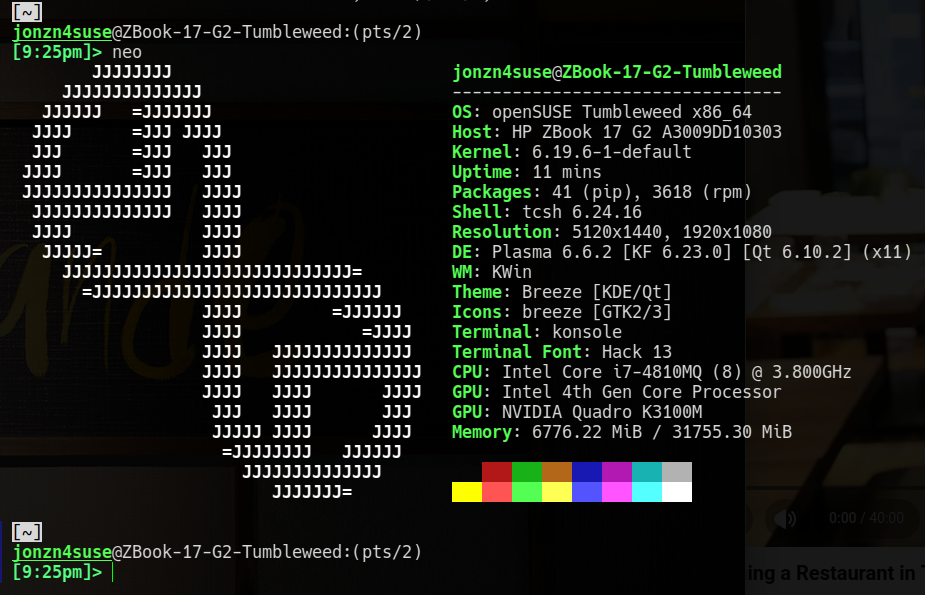
Here is my fastfetch info. Technically the 470 nvidia driver is EOL, so I may be stuck with this kernel.
I have an old PC which has a motherboard from 2009 & a Pentium II processor! I think I bought it in 2010.
It is still going strong, although Windows is long gone. It has distro hopped quite a few Linux Distros but has finally settled on Tumbleweed & migrated that to Slow roll for ease of maintenance.
By now it is a bit of a Frankenstein machine as it has had transplants of new RAM, and extra HDD, a new SSD that Slowroll is running from & an old recycled graphics card from another machine that died to give HDMI connection rather than being stuck with VGA .
Works quite happily as a streaming machine to watch things ad free via Firefox in my exercise room.
System Details Report
Report details
Date generated: 2026-06-24 11:13:14
Hardware Information:
Hardware Model: ASUSTeK Computer INC. P5G41T-M LX2/GB
Memory: 8.0 GiB
Processor: Pentium® E5800 × 2
Graphics: AMD Radeon™ R7 200 Series
Disk Capacity: 1.3 TB
Software Information:
Firmware Version: 0405
OS Name: openSUSE Tumbleweed-Slowroll
OS Build: (null)
OS Type: 64-bit
GNOME Version: 50
Windowing System: Wayland
Kernel Version: Linux 7.0.12-1-default
# zypper lr
...
# | Alias | Enabled | GPG Check | URI
--+-------+---------+-----------+----------------------------------------------------------
...
2 | KDE3  | Yes     | (r ) Yes  | http://download.opensuse.org/repositories/KDE:/KDE3/16.0/
...
I may be the only KDE3 user frequenting these forums. Most (all?) using it have been using it 20 or more years and rarely need any help with it. When they do they tend to use kde3@lists.opensuse.org.
I just successfully updated a 2008 lenovo thinkpad 500r laptop to tumbleweed from leap 15.6.
It would not update to leap 16.0 due to restrictions within opensuse-migration-tool so I updated to tumbleweed. I think leap 16.0 was restricted due to 32bit vs 64 bit restrictions. Update conducted using migration tool.
mate desktop and plasma desktop will run thus far.
 Thanks for the feedback, everyone.