I’m referring to system-update.target, like dnf5 upgrade --offline && sudo dnf5 offline reboot provides on fedora:42; [1] not updating without an internet connection (per se) like:
Maybe you better describe what your goal is. Referring to how another distribution does something thinking that other openSUSE users will now understand it will shy away a lot of them.
And for me the title is also unclear. When I want to do a reboot, I do a reboot. If the system is on-line or not is then of no importance.
Thus I assume that you could explain much more about your goal.
@hcvv, did you read the cited SystemD documentation? (The DNF command is merely an implementation of it.) It describes a method of reboot whereby packages are updated within a minimal boot environment, to reduce the probability that having a running OS could impact their ability to overwrite their predecessors’ contents.
Do you mean something like Introduction of soft-reboot?
(I personlly have no experience with, I just read the article once…)
No, I didn’t. I do not see any Systemd citation in your first post. I stopped reading more or less when you started assuming that your readers would have any more knowledge of Fedora then that it exists and is a LINUX distribution. But forget my remark, when you can be helped by those people who know more about Fedora, that is of course very fine.
@hcvv, I mentioned system-update.target before I ever mentioned dnf, and I really don’t understand why this is worth mentioning. We’re not all experts in everything, but that shouldn’t impact whether we utilise examples from outside our sphere of knowledge as mere examples, where relevant.
@C7NhtpnK, I don’t believe so, because I believe that soft-reboot.target doesn’t send the reset EFI command to the motherboard firmware. The kernel wouldn’t be able to remain active otherwise.
First, it is systemd (not SystemD, not SySteMd or any other variation). Second, you did not cite anything unless you count the single word system-update.target as “citing documentation”.
Explain what you are trying to do. The goals not the means.
2 Likes
@arvidjaar, perhaps you’ve missed Discourse’s citation marker? It’s the grey pill:
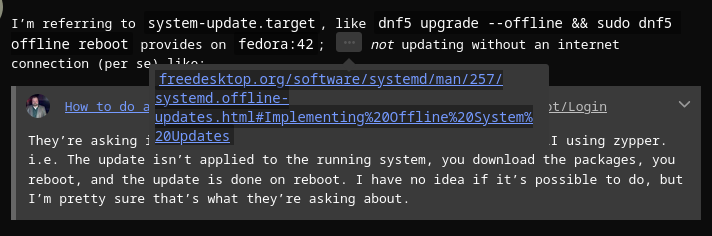
It’s at /html/body/section/div[1]/div[3]/div[2]/div[2]/div[3]/div[4]/section/div[1]/div[2]/div/div[1]/article/div[1]/div[2]/div[2]/div/p/a:
<a class="expand-footnote" href="" role="button" data-footnote-id="#footnote-1318401-1"><svg class="fa d-icon d-icon-ellipsis svg-icon svg-string" xmlns="http://www.w3.org/2000/svg"><use href="#ellipsis"></use></svg></a>
If so:
-
The documentation is at
freedesktop.org/software/systemd/man/257/systemd.offline-updates.html#Implementing%20Offline%20System%20Updates. -
For any administrators reading this, citations can render as entrants to a bibliography, but whoever configured this instance decided to have them render as pills. It’s not intuitive.
Explain what you are trying to do. The goals not the means.
That was meant to be in the title, but I appear to have mistyped: “reboot” should be “update”. I want to perform an offline update, which is the purpose of that target.
I now understand why you all were confused. Those together would be.
How is forum topic related to the systemd documentation?
Anyway
Offline updates are implemented by PackageKit and you can use any of the available frontend like pkcon, GNOME Software or KDE Discover.
@arvidjaar, ultimately, packagekit.service delegates to a zypper backend. I want to know how to achieve this via zypper, because pkcon isn’t 1:1 with zypper, especially in dependency resolution. Thanks, though.
I don’t know what you mean by that.
I’ve little desire to request a rephrasal, because this really isn’t important. Because of that, I’ll instead elaborate, in the hope that you understand me, although am glad to hear if I’ve misunderstood.
To reiterate, I mentioned that feature of Discourse because you asserted I hadn’t cited any documentation, which I had. In retrospect, it’s hidden by Discourse’s citation visibility control button, so I presumed that that was why you had stated I hadn’t cited it: because you’d missed it. If not, please inform me what why you asserted that I hadn’t.
If an administrator can update that, please do. The very quick edit timeout on this instance prevents me doing so.
@arvidjaar, yes. I appear to have learnt from old documentation:
I do not understand this question.
Are you asking “is there zypper option for performing offline update”? No, there is not.
Are you asking “is it possible to implement offline update using zypper command”? Yes, it is possible. Just read the systemd documentation you mentioned so many times which describes how to do it using any program. Use zypper install --download-only to prepare update and create a service that will do zypper dup using downloaded packages.
If it means that pkcon does not ask you - offline updates are intended to be non-interactive, so it does not matter in practice.
1 Like
There is a single configuration option, which is to allow footnotes to be expanded online. The default setting was used, but I have changed it. I’ll have to look and see if anything has to be done to re-bake the message in the morning. I suggest just linking rather than trying to use that functionality so it’s clear when you are referring to docs.
Title edited for clarity as well. Reporting the message is the best way to call staff attention to something like this - we don’t necessarily see every message.
1 Like
- Pull in some local service, e.g. by creating the following link:
i4130:/etc/systemd/system/system-update.target.wants # ll
total 4
lrwxrwxrwx 1 root root 31 Jul 31 10:22 dup.service -> /etc/systemd/system/dup.service
i4130:/etc/systemd/system/system-update.target.wants #
- Create
/etc/system-updateand reboot. The system will boot intosystem-update.target, remove/etc/system-updateand startdup.service. Upon completion it will reboot intodefault.target.
1 Like
@arvidjaar, that was what I wanted to know. Thank you. Likewise, @karlmistelberger.
This topic was automatically closed 7 days after the last reply. New replies are no longer allowed.