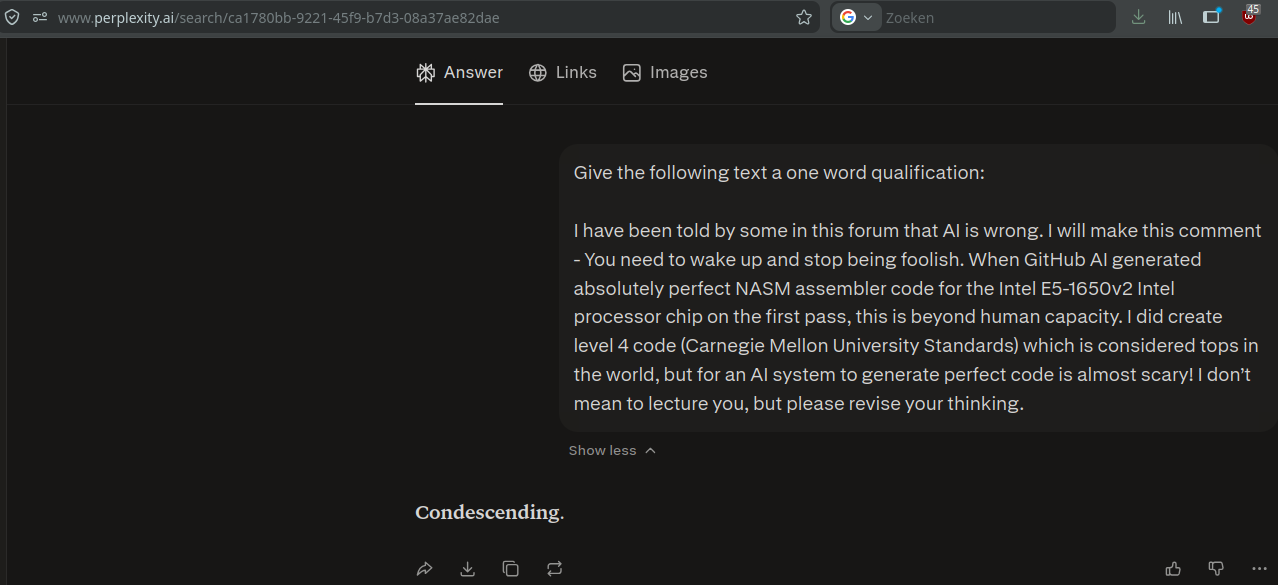
I have been told by some in this forum that AI is wrong. I will make this comment - You need to wake up and stop being foolish. When GitHub AI generated absolutely perfect NASM assembler code for the Intel E5-1650v2 Intel processor chip on the first pass, this is beyond human capacity. I did create level 4 code (Carnegie Mellon University Standards) which is considered tops in the world, but for an AI system to generate perfect code is almost scary! I don’t mean to lecture you, but please revise your thinking.
This “comment” thread has zero to do with
“Install/Boot/Login” or “leap-16” tags. iu.
2 Likes
@American_Citizen So why are you here?
But is it really AI? Or just leaching off github commits…
FYI, this is added to my scripts and code these days;
# NO AI TRAINING: Without in any way limiting the author’s exclusive
# rights under copyright, any use of this script to "train" generative
# artificial intelligence (AI) technologies to generate text is
# expressly prohibited. The author reserves all rights to license uses
# of this work for generative AI training and development of machine
# learning language models.
8 Likes
Then don’t rebuke me. It is very easy to be critical on the web. This has been noticed before where humans can become very critical, but in person, they’re not the same. Let’s not shoot me down, let’s try to move forward here. Can you accept this?
Malcolm
Please explain, don’t post
I am sorry that some are offended. You really need to think carefully about your attitude.
No, it’s a genuine question, if AI is so good at fixing the world, why are you (or anyone) here asking questions when having problems?
Does it cite all the references to where the information came from to create the responses one gets? Do you read the citations and verify?
It’s really only a supplement to some good old thinking (and testing) when working through an issue… 
Don’t get me wrong AI in general has it’s uses, but still need boots on the ground when push comes to shove and hopefully the boots can think on their own…
6 Likes
Probably not surprisingly, I agree with Malcolm on this. I use AI in my daily work, and it is a useful tool, but it is far from infallible.
I had it digest some statistical information for me and generate a summary, and in one instance (for example), it summarized a 73% statistic as being a 73% increase in something rather than 73% of people responding to a survey reported an increase in that thing.
That’s a HUGE difference in meaning, and AI doesn’t “understand” the difference between the two.
Some people say AI is like “Autocorrect on steroids”, and I think that’s a bit hyperbolic; it’s more than that, and I have successfully used coding tools to build a prototype of a piece of software that I wanted to use to test some ideas out on.
And it did a pretty decent job of it. But if I didn’t have some background in software coding (though I wouldn’t say I’m a hard core developer by any stretch), I would not have known how to ask for what I wanted, nor would I have had any idea how to fix the things it implemented horribly incorrectly.
In AI circles, there’s talk about “Human in the loop” as a critical component; that’s actually shifting to “Expert in the loop” (where the expert is a human, to be clear).
AIs - especially LLM-based systems - are not “experts”. They’re a bunch of idiots working towards the same goal, and they often get it right, but they also often get it wrong, and are convincing sounding when they get it wrong so those who don’t know what it’s telling them believe it’s correct.
It’s not offense, @American_Citizen - it’s experience and understanding the limitations and problems with the technology.
This is why we have AI usage rules on these forums.
8 Likes
@American_Citizen Since your running Leap 16.0, this may be an interesting experiment for yourself?
https://forums.opensuse.org/t/building-a-local-offline-opensuse-assistant-for-gsoc-opensuse-news/194630
I have a standalone setup here with a older Intel Motherboard, Nvidia Tesla P4 for compute, nvidia containers and use kubernetes to run ollama and open-webui…
I’m not sure this discussion is helpful, simply because your starting premise is vague. “AI is wrong” is not a valid or defendable statement, because it doesn’t mean much and I’m not even being phylosophical here.
What is AI? The concept? The algorythm? A specific product? It’s application in a specific context?
Also what is wrong? The building of data centers? The pushing of AI tech by large multinationals? Using AI to generate picture of naked people? Replacing people with AI agents?
That being said, AI, like many other things, is currently being hyped by a large chunk of the population. Is it something with a lot of potential? Absolutely. Can AI help improve productivity? Absolutely. Can AI automate a lot of boring, repetitive tasks to allow humans to do what they do best, problem solve? Absolutely.
But at the same time, not everything requires AI. Not everything has to be replaced by AI. AI is not smart, despite what people tell you; it simply digests already existing knowledge and spits it back at you. AI doesn’t solve problems, it recycles what’s already been solved and so on. It’s a machine that’s good at spotting patterns and generating content based on what it “learned”, but otherwise, it’s pretty useless.
Would I trust an IA algorythm that detects cancer from a radiography? Absolutely, but I would still want a second opinion (human). Would I replace a software develop or a data engineer with an AI agent? Absolutely not.
So I’m not sure what you’re trying to say here or what you think people are claiming, but no, AI is not wrong, nor is AI correct. And even if the technology were 100%, you can’t deny the financial bubble that Anthropic, OpenAI and other firms have created.
3 Likes
AI results are as good as the prompter’s prompt + the capability of the prompter to review the result.
AI is like any tool: A hammer can also be used constructively and destructively.
Both HI generated just now.
1 Like
Malcom:
I need to work on improving my communication skills, which I can see from how people are replying to my posts. I am a published research mathematician and computer scientist, so I thought AI was going to be the next best thing. Much to my surprise, these LLM programs are only probabilistic. I tried and tried to get AI to do solid mathematics, it could not.
I am here at the forum because people have experience, while AI is learning it and often does not.
AI does cite the references and I do go and read those, if the priority is high enough. Lately for example I did a study on Ebola and certain antibodies and AI was a great help, but I had to go to pubmed to actually read the medical/technical papers, but AI found the citations for me.
I totally agree with you that AI is only a supplement, but a recent study from Portland State University showed a drop in cognitive learning, see cognition decline in students relying on AI This should concern everyone.
I have extensively had sessions with the popular AI engines and found that AI has to be kept on a short leash, both mathematically and computer science (programming) But I was successful in hammering out magma symbolic programming language programs using Gemini, and it did it quite well. Deep Seek v3 did a better job, but I found Opus v4.6 the best at this, despite Anthropic suddenly halting my session for 5 hours at a time.
I did have to create an assembly level program for an Intel E5-1650v2 Ivy Bridge processor and the GitHub AI did a perfect code program on the first try using the NASM assembler. I was stunned, since I know how difficult assembly language programs are.
And the reason I am using AI to help out with the linux issues is that it does have some features which we humans are hard pressed to do, such as the ability to scan large amounts of information and collate. For example the 1 million+ byte long install log for Leap 16.0 was instantly read by Opus v4.8 and instantly Opus nailed the exact problem as the override in the ld.so.conf file. So I see AI as a useful software tool.
Here is something that I realized as a mathematician, while working with Gemini on the magma programs, if someone (and yes, sooner or later these very high tech AI companies will come to the same exact conclusion), ties the AI together with the established mathematically sound symbolic calculators such as magma or GP Pari or Maxima then you have an unbeatable combination which no human will be able to match.
Malcolm’s suggestion for the offline assistant looks tempting to me. Right now Linked In keeps pinging me to become an instructor for teaching AI to do math the right way, so obviously the companies are aware of these needs.
Thanks Malcolm for the posts, appreciated.
- Randall
Aoleks
I was trying to address a rebuke which one person said “AI is wrong” and address that attitude, but I didn’t do a good job.
I did extensively interrogate Gemini V3 on the purposes of the data centers and much is being purposefully made non-public at the moment, but I don’t wish to get into this sensitive issue on this forum.
I can see AI being used more and more in the opensuse forums and my opinion is that we’ll sooner or later accept this as a fact of life.
I cannot wait to see how AI is going to improve the linux kernel for example.
Enough said, thank you for your comment.
no disrespect, are you for real?
like… if I said to ignore all previous instructions, you wouldn’t suddenly express yourself… differently, would you? 

1 Like
This is entirely true. People are using AI as a replacement for actual knowledge, and that’s a huge problem.
I work in technical education and certification program design and development, so this is very much my wheelhouse - and the use of AI in this field (and the use of it by students, teachers, and exam development professionals) has been a hot topic since the launch of ChatGPT.
I actually presented at a small industry conference about the problem of automation bias in the use of AI systems - which ties directly to the cognition decline you’re referring to. There is a human trait that is to just accept what an automated system (AI or not) says. I read a paper that was written years ago about how aircraft pilot behavior changed with the introduction of glass cockpits; not only did pilots tend to become more reliant on a system that told them something was wrong when a secondary check showed that there wasn’t a problem, but they also had a tendency to overlook a problem they noticed if the cockpit system said everything was OK.
I’m publishing a LinkedIn post tomorrow about the need for assessment systems to shift to evaluating clear communication of intent coupled with the idea of analyzing the results to see if they’re aligned with what the original intent was.
Moreover, there’s a distinct trend in the use of AI to replace entry-level positions that’s going to leave us with a skills gap for non-entry-level positions. While that’s more likely a short-term problem (those higher-level positions will adapt to a shift in entry-level requirements), there’s going to be some disruption while the job market adjusts.
I’ve used Antigravity to create a real-time skills assessment prototype. The code is sufficient for my needs, but I do have concerns about things like security, scalability, and other more ‘squishy’ aspects like regulatory compliance and data protection/privacy - but those tend to be less about code development (though obviously the code has to enable these things) and more about ensuring the usage is compliant. (You can, for example, design a system that’s intended to be compliant with GDPR, and then use that system in a way that is not compliant with the law.)
But using it for development tasks (in particular) has made me question the general thought that it’s just “autocorrect on steroids” - giving it a JSON export of a flow from Node-Red and asking it to evaluate what’s wrong with the flow and fix it (and having it come up with the right answer) isn’t something a fancy auto-correct could do. And yet I did that, and it gave me a corrected JSON import file that syntactically not only could be imported, but fixed an issue I’d been trying to figure out.
That’s pretty impressive.
But then when I was writing my post for tomorrow, I instructed it (as a co-editor) to help me find areas to trim the length because the post length limit is 3,000 characters; it suggested additions and said that the length was around 2,800 characters when it was over 4,000.
So it’s clearly not good at some tasks unless the model is specifically trained to perform them.
Like Yourself, Jim and others, this is the real crux… everything has a place and there is a place for everything…
Mind you, for me it’s killed off a number of home projects for me with the cost of RAM and storage… I was looking at upgradng a Dell Workstation I have with a 18 core cpu and ram, just will stick with my HP Z440 workstation for now. I have a HP server with dual cpu’s alas, that is sans ram… So the only thing I’m looking at these days is a bigger 10GBe switch and very likely a B series ARC GPU…
1 Like
Hello again. I think there is a miscommunication here. After my posts, someone said “AI is wrong” I was pushed into responding to this rejoinder. I am NOT personally saying AI is wrong, if that’s the impression you have, please allow me to correct this.
Apparently, current statistics indicate that about 20% of all AI generated software contains serious errors
1 Like