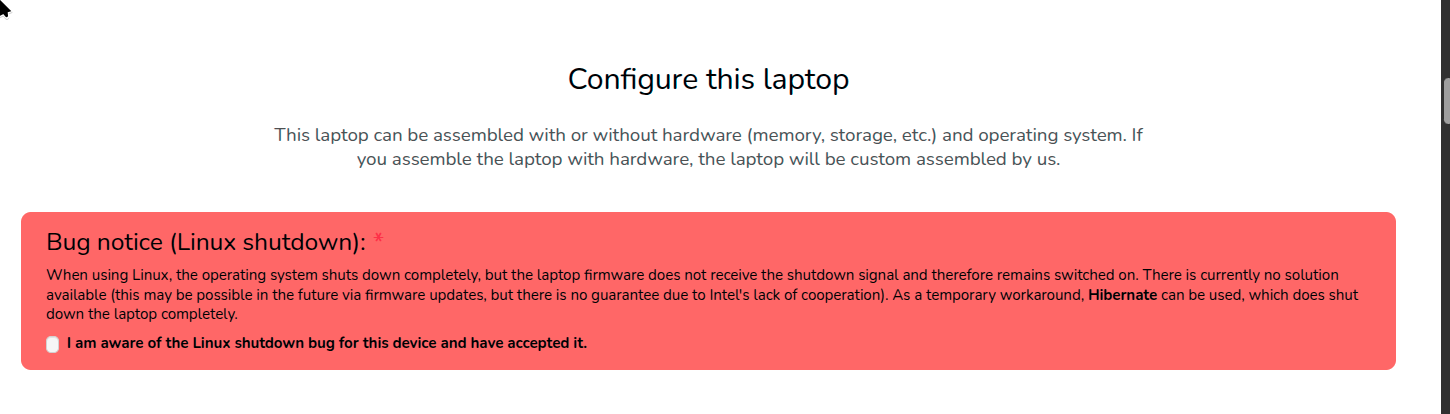
When using Linux, the operating system shuts down completely, but the laptop firmware does not receive the shutdown signal and therefore remains switched on. There is currently no solution available (this may be possible in the future via firmware updates, but there is no guarantee due to Intel’s lack of cooperation). As a temporary workaround, Hibernate can be used, which does shut down the laptop completely.
I am aware of the Linux shutdown bug for this device and have accepted it.
to which kind of piece of hardware this notice is related and what I have not to buy?
But AFAICS the hardware selection isn’t all that huge:
You can choose between 2 CPUs, an Intel Core i5 i5-1335U or an Intel Core i7 i7-1355U. Both appear to come with the same mainboard, and shutting it down is handled on the mainboard via the firmware.
Other vendors offer a lot more variety, from CPU architecture to CPU maker and the specific CPU type, all of which require a different mainboard and in most cases different firmware, so there might be a chance that such a problem (if it exists) only affects a subset of all those combinations.
Here, I’d guess that they are all affected. I wouldn’t put my faith in a firmware update that may or may not come; much less since they appear to be on bad terms with Intel (“due to Intel’s lack of cooperation”). If you want a carefree life with Linux on your laptop, you might want to consider other hardware.
OTOH if you only ever suspend the laptop to RAM anyway (like I do), this might also be a complete non-issue. I rarely shut it down completely.
As this warning only appears for their entry model laptops, and not for the mid-end or high-end models, one could think that they use an EOL or really cheap motherbord for their entry level. This would explain why there is no firmware update.
yes, a friend of mine asked me if I have a suggestion on a 14" linux compliant laptop and I was looking something and hit this problem
and not it isn’t related with my recent issues
my point is what could be the element that has this problem with linux and after reading here I get that is the intel motherboard
I’ve been buying Lenovo laptops for a long time, and my experience has always been that all components worked well on Linux. But they tend to be in a higher price region, too. I also hear good things about Dell laptops.
If you are on a budget, consider refurbished second-hand laptops; many companies replace them after just a few years when there is still a lot of life left in them. That might bring a brand into your budget range that would otherwise be out of reach.
Whatever you choose, check online forums what other users say about the Linux compatibility of that specific model.
   halt
       Shut down and halt the system. This is mostly equivalent to systemctl start halt.target
       --job-mode=replace-irreversibly --no-block, but also prints a wall message to all users. This command is
       asynchronous; it will return after the halt operation is enqueued, without waiting for it to complete. Note
       that this operation will simply halt the OS kernel after shutting down, leaving the hardware powered on. Use
       systemctl poweroff for powering off the system (see below).

       If combined with --force, shutdown of all running services is skipped, however all processes are killed and
       all file systems are unmounted or mounted read-only, immediately followed by the system halt. If --force is
       specified twice, the operation is immediately executed without terminating any processes or unmounting any
       file systems. This may result in data loss. Note that when --force is specified twice the halt operation is
       executed by systemctl itself, and the system manager is not contacted. This means the command should succeed
       even when the system manager has crashed.

       If combined with --when=, shutdown will be scheduled after the given timestamp. And --when=cancel will
       cancel the shutdown.
   poweroff
       Shut down and power-off the system. This is mostly equivalent to systemctl start poweroff.target
       --job-mode=replace-irreversibly --no-block, but also prints a wall message to all users. This command is
       asynchronous; it will return after the power-off operation is enqueued, without waiting for it to complete.

       This command honors --force and --when= in a similar way as halt.