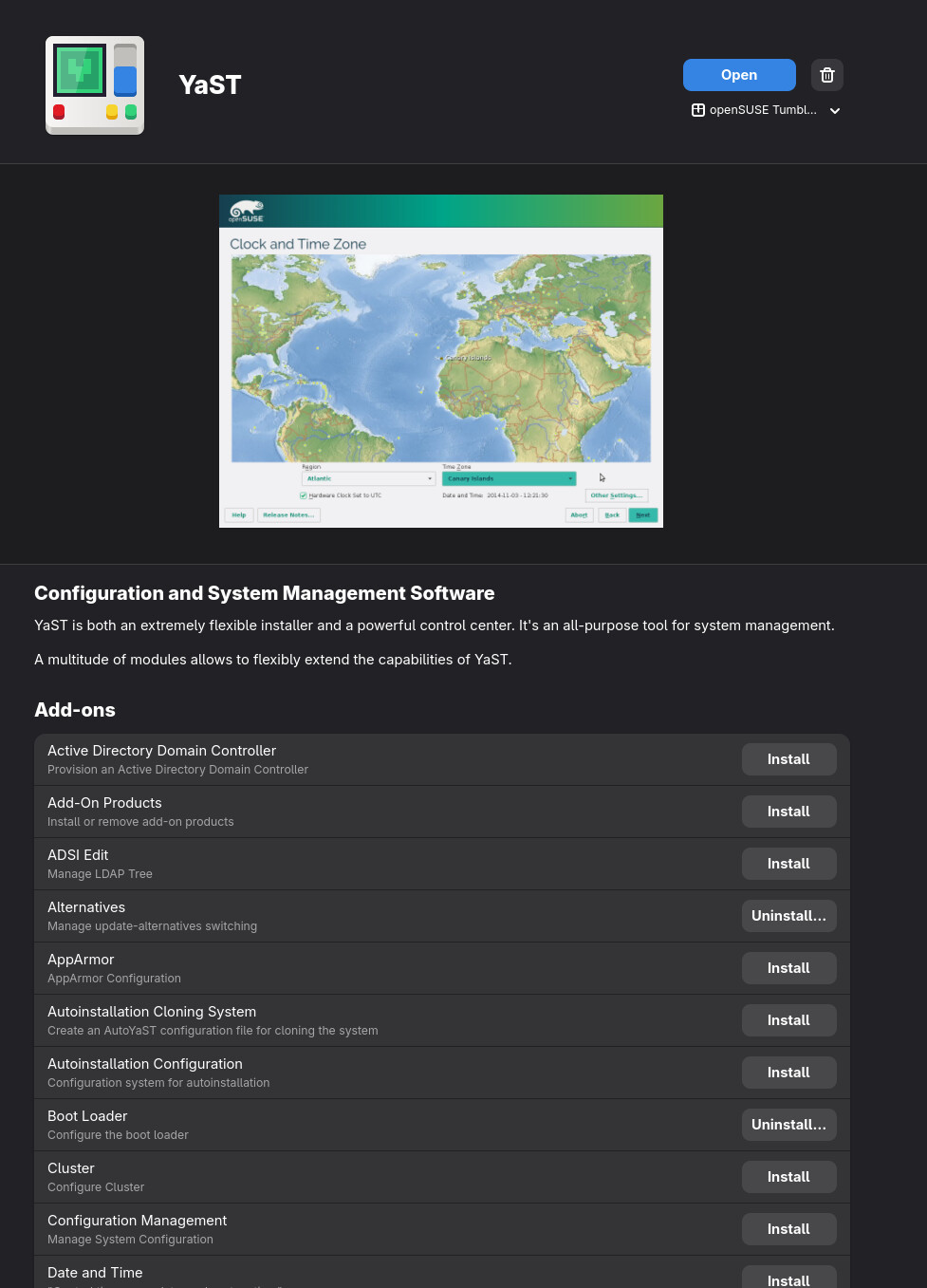
In Gnome Software YAST is in there & offers a whole loads of addons to install & the partitioner that you mention is on there and installed on my system as part of YAST which I’m still able to use at the moment.
1 Like
An interesting point here. YaST is wonderful, etc., but for most Linux users, it wasn’t really a factor. Many people here overestimate the impact of a tool like that. Mint doesn’t have anything similar, yet it manages well enough to be frequently recommended as “the distribution for beginners.” Arch-based distributions are currently taking the lead in recommendations for gaming.
Many of us like YaST, but for one reason or another, it hasn’t exactly been a massive success.
1 Like
YaST is great and it is sad to see it go, considering the place it held in defining the SUSEness of SUSE for so long. But, for better or for worse, time trudges along and, like X11, if the YAST2 developers have said it’s not worth trying to maintain in light of the alternatives, then we have to choose: Cling to the old tools and try to keep them on life support, or adapt to the new tools and make them better.
And, just like the X11-to-Wayland transition, there will be hiccoughs here and there and people will grumble that the transition was too soon or ‘rammed down their throats’, but they will get better over time as more people switch over.
Sysvinit gave way to systemd, oss was replaced by alsa, pulseaudio was replaced by pipewire… Sometimes the transition is smooth, sometimes it isn’t, but we usually end up in a better place by the end and the more people working together on it the faster we get there.
…Or people leave and start their own distribution with blackjack and hookers, but that’s always been an option.
3 Likes
Good psychotherapy!!! 

 Totally agree! Bad thing: several significant transitions and inconveniences appeared at the same time.
Others have noted advantages; but in particular (and as others noted), Packman was never an issue for enterprise customers because there were other ways to legally obtain the codecs for enterprise customers, if they even needed them (the majority of enterprise customers use it as a server, and codecs generally don’t matter for servers).
If YaST was an advantage from a commercial standpoint, then I would imagine that SUSE would have found a way to continue it. So I don’t think your logic on that front holds.
As for packages vs. Flatpak…supporting Flatpak increases packaging ability for those who want to provide distribution-agnostic packages. Flatpak is not without its problems, but neither is RPM (or DEB or whatever).
Packaging for the community distributions is a volunteer effort, which means that anyone who wants to maintain packages can learn how to meet the standard and package them. So if there’s a package you want, you can always step up and learn how to package it and maintain it, rather than grouse about there not being as many packages.
You want YaST? Great, volunteer and help maintain the code and packaging for it. As shundhammer noted, contributions can come in forms that don’t involve coding. That would be a much better use of time than lamenting at the loss of things you wish weren’t going away. If they’re that important to you (and others), you have the ability to make it happen. Don’t wait for others to decide, you have the ability to do that.
1 Like
The thing that makes me sad with Yast leaving is that it has a lot of modules for things that are essentially edge cases that are not available anywhere else except full manual terminal config.
For instance, I use iscsi in my network. Previously, this was a real PITA on Fedora with having to write custom scripts just to make the config survive a reboot. With Yast and the iscsi module it is literally just a matter of copying the correct target, saving and updating your mountpoints in /etc/fstab. 10 seconds work, 30 seconds tops if you are being slow and triple checking for mistakes. Typing out huge scsi commands on the CLI, not so much. And there are more of these where Yast just makes life quick and easy whereas the alternative elsewhere (or whithout) is maybe not really difficult, but definitely significantly more complex and error-prone.
1 Like
Who cares about enterprise customers?! I always used free versions of SUSE, then openSUSE TW on a desktop - and it was just perfect for this!!! Yast + perfect stability + Packman (codecs) gave SUSE a lot of popularity. And it is still positioned in this way - see emphasized items below on the https://www.opensuse.org/ page:
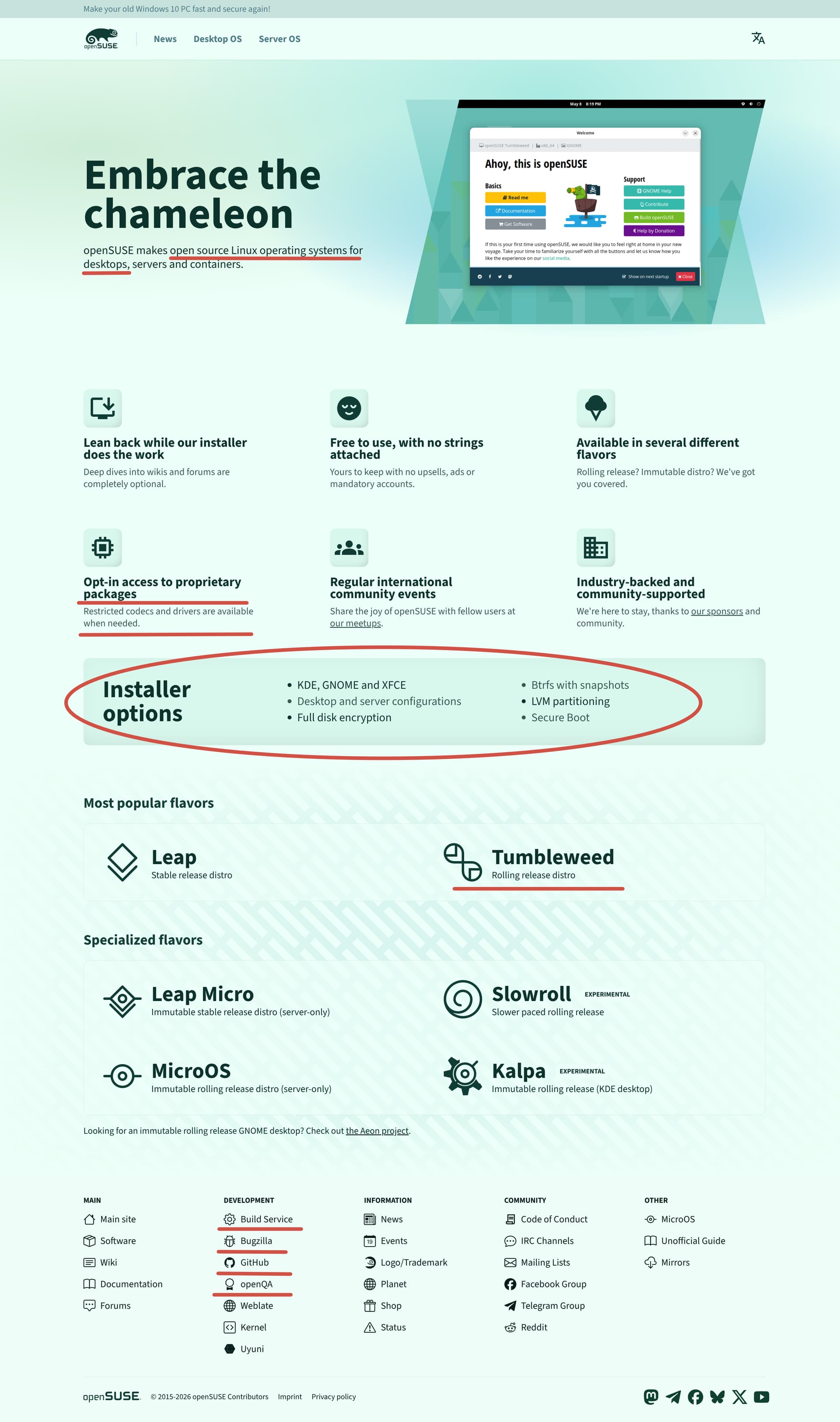
So such argument is very strange on this forum!
Some good advantages appeared are good documentation and Open Build Service which become very useful and powerful recent decades.
1 Like
Um, targetcli saveconfig I use iSCSI here, script is pretty basic…
##CREATE IQN
#$TARGET_CLI iscsi/ create iqn.$(date +%Y-%m).$IQN_DOMAIN:$IQN_INITIATOR_NAME

##CREATE PORTAL
#$TARGET_CLI iscsi/iqn.$(date +%Y-%m).$IQN_DOMAIN:$IQN_INITIATOR_NAME/tpg1/portals create $PORTAL_IP $PORTAL_PORT

##CREATE BLOCKSTORE
##$TARGET_CLI backstores/block create $LUN_BLOCK /dev/$BACKSTORE

##CREATE LUN
$TARGET_CLI iscsi/iqn.$(date +%Y-%m).$IQN_DOMAIN:$IQN_INITIATOR_NAME/tpg1/luns \
            create /backstores/block/$LUN_BLOCK $LUN_NUMBER
##ADD PERMISSIONS
$TARGET_CLI iscsi/iqn.$(date +%Y-%m).$IQN_DOMAIN:$IQN_INITIATOR_NAME/tpg1 \
           set attribute authentication=0 \
           generate_node_acls=1 \
           demo_mode_write_protect=0

##SAVE CONFIG
$TARGET_CLI saveconfig
Oh, and Agama installer can take care of iSCSI, or use a profile…
SUSE does. And SUSE’s the company that maintained YaST for so long.
It comes down to the same thing I have said a thousand times: If you want YaST to continue, contribute to its continued maintenance. Complaining about it is not going to bring it back.
1 Like
I do not insist on Yast, I just wish SUSE remains the best on desktop.
SUSE != openSUSE. It hasn’t, since 2005. Please stop confusing and conflating them.
You haven’t been using a “Free version of SUSE”, because there is no such thing, and hasn’t been since 2005, other than the limited availability of the Developers Licenses.
openSUSE Leap is the closest thing to a “Free version of SUSE” that exists, and that has only been around since 2015. So when you claim you’ve been using a “Free version of SUSE” Nobody has any clue what you’re talking about.
it is openSUSE forum! I do not care about commercial version.
Then stop calling it SUSE. SUSE is a company, they make a version of linux called SUSE Linux Enterprise, which basically has nothing to do with openSUSE.
Don’t tell me what to do! It is small (minor meaning) case open and capital (major) SUSE in the name, I used to just SUSE since 2000s. Don’t focus on the wording; just stick to the point!
1 Like
I will be happy to, when you make any sort of sense, your continual confusion of terminology makes whatever point you’re trying to make, very difficult to follow.
@akontsevich This discussion has run its course. Continuing to recycle the same arguments and derailing the discussion with repetitive, non-constructive commentary serves little purpose.
Thread closed.
5 Likes