Some swap usage is not so bad. There is code used at boot-up that stays in RAM (or swap) but is never used again until reboot, so swapping it is almost harmless.
Decreasing swappiness with an HDD might not be a good idea with some user loads. Say that RAM is almost full and you open an heavy app (GIMP? Darktable? Even Firefox these days?): instead of swapping 500 MB in a single chunk you end up swapping 50 MB at a time with a tenfold increase in swapping delay (with rotating rust head repositioning is what counts).
System defaults are sensible, playing with swappiness you must really know what you are doing. Different story with SSD or NVME though.
1 Like
Makes sense, it has been a long time since I ran the boot OS from an HDD 
My thanks to all who have posted. Suggestions and conclusions often aligning with my own thoughts - just needed communal confirmation 
My apologies again to Henk - I was clearly not thinking straight (geen Nederwiet, geloof me!!!).
Any further ideas or suggestions remain welcome.
Difficult to suggest anything else unless you tell what kind of disk and what filesystems you use for /root and /home…
1 Like
I’d echo previous comments about needing more RAM and replacing the HDD with an SSD - those should make a big difference.
I wouldn’t say that Obsidian is lightweight, though. Being an Electron app, is basically runs a whole web browser.
My Opensuse is an ancient desktop machine with 8GB memory. A few years ago I installed an SSD and that made the system much much slicker.
But a year or so ago it started slowing down, and I reckoned swapping was to blame. So I stopped using Firefox and used Brave instead, and now I have my wonderful fast computer back again.
Your mileage may vary of course.
1 Like
The 8GB option is in the pipeline but we have already tried the move to Brave sadly with little change. It is true that Brave will filter out a lot of the advertising bloat but this is a professional machine principally accessing a professional veterinary supplier (little or no third-party advertising), a veterinary forum (idem advertising) and a banking site. Even on these low performance sites, Brave is about as slow as Firefox. Thanks for the suggestion though.
1 Like
The content used in Obsidian is all lightweight markdown text locally hosted - basically just animal anamneses and diagnostics - with some linked pdf files.
It would be interesting to see the results of the SMART Test.
Like others think also the 4GB RAM is causing the slowness.
But, I think you should convince yourself so assuming you run KDE:
- Start the System Monitor, Start → System → System Monitor
- Have a look at the Memory, I like the History tap. If you have swap also have a look at that.
- Make sure this window keeps visible and start Thunderbird/Firefox and LibreOffice and see what happens.
You should see something like this, but for you the limit should be 4 GB and I think I know what you will see.
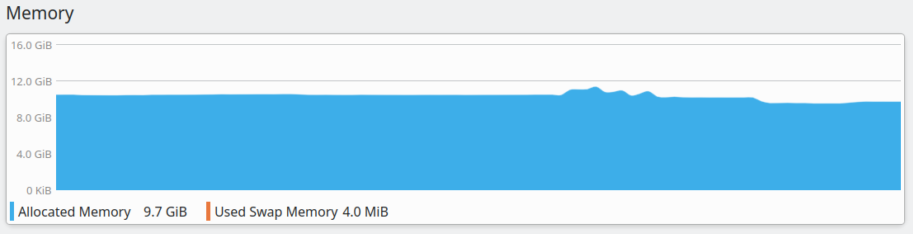
The “megabloat effect” I had installed my first SUSE Linux in a 20MB partition on a PC with 8MB RAM. I could use X11 and Emcács inside, but when I also started gcc from Emacs inside X11 using “-O2” the system became slow. 
2 Likes
For the records XFCE takes under 1GB (free reports used=948124 with only a terminal open) but then you just open this page in Firefox and you see used=1518604.
Well, I remember systems with KB of memory, but that’s neither here nor there, nor is it helpful to the OP’s issue - so let’s stick to working on that issue here, rather than reminiscing.
2 Likes
As a fellow KDE user on older hardware, I recommend disabling all »file search« and quick-indexing features that Dolphin and KDE offer if you can do without those.
I even uninstalled most of baloo/milou (rpm packages used for file indexing, search and metadata analysis). Instead, I use combinations of find and file on the command line. (I do that on Linux, macOS and Windows, one of many time-tested ways to separare my workflow from the platform used). Cheers!
2 Likes
Good idea! Thanks - I shall give it a go
@TijgerD Did you check the device? Also not that the i/o scheduler has changed as well, might want to check that.
This could indeed be the ultimate root cause. It is a completely bog-standard out of the box install so the entire HDD is BTRFS. I would like to split off the system volume from the home volume but being a key (read the only) machine dedicated to the veterinary practice, I am loathe to tinker too much…
Check if there is a /var/log/journal/ directory on the system. If you can afford not having a persistent journal (i.e. journal is cleared at reboot) you may remove that directory since man systemd-journald.service reads:
By default, log data is stored
persistently if /var/log/journal/ exists during boot, with an implicit fallback to volatile storage otherwise.
and writing journal entries to slow HDDs with BTRFS might significantly slow down the system.
In such a case, an immediate investment in new hardware is urgent. There’s even slower than the slowest, which is dead hardware. Performance is not their issue.
1 Like
SMART considers: SMART overall-health self-assessment test result: PASSED but does signal a small number of errors However, I note the following prefailure warnings for
1 Raw_Read_Error_Rate POSR-- 114 098 034 - 82250432
3 Spin_Up_Time PO---- 098 098 000 - 0
5 Reallocated_Sector_Ct PO–CK 100 100 036 - 0
7 Seek_Error_Rate POSR-- 075 060 030 - 77792520755
10 Spin_Retry_Count PO–C- 100 100 097 - 0
196 Reallocated_Event_Count POSR-- 088 088 030 - 11083 (11093 0)