It’s not an openSUSE issue, it’s an IP licensing issue.
This has been discussed repeatedly in this very topic, as well as being well-documented for years. Ire at the openSUSE Project is misplaced - put it on those who decided that monetizing the IP was more important than making the technology widely available for all to use.
That is where the problem lies. It is absolutely reasonable that SUSE, as the openSUSE project’s main sponsor, doesn’t want to be the ‘deep pockets’ that some patent troll decides to sue because the project included patent-encumbered technology in the distribution.
Other distros made their own decisions, and SUSE made theirs. You want X, but there isn’t a legal way to do it beyond what has already been suggested.
It is unreasonable to expect SUSE to break the law so you can watch Youtube (or whatever you need the codecs for). If you want to take the risk (or if you live in a jurisdiction where this isn’t an issue), then that’s what the proposed solutions do.
As an open source community, how can we reasonably expect anyone to respect the GPL or other open source licenses if we’re not going to respect the licenses that this technology is provided under? We don’t have to like those license choices, but we do have to live with them until such time as the patents have expired.
… but they didn’t pay for the SW needed by that HW to work and they cannot expect that others pay for them.
Cisco was kind enough to pay for everybody to use libopenh264.
Nvidia apparently paid for those using their proprietary drivers (but you need select players to directly take advantage of that, those using ffmpeg still need Packman or Videolan or Flatpak).
People cannot expect SUSE (or RedHat) expose themselves to legal action in the jurisdictions where they do the business that, by the way, support also openSUSE (and Fedora).
And openSUSE cannot risk losing their main sponsor… or do they?
SUSE does not own or control OpenSUSE unless something has secretly changed. So no, OpenSUSE doing something does not hold SUSE liable. There’s an argument here, but it has to be about things SUSE has expressly done.
But the whole thing is kind of silly since no distro has ever been sued, Packman was around for 25 years with no legal trouble, and that nuclear weapon of patents large corporations have pooled together to defend Linux itself could very well be chosen to be employed against someone coming for a distro. If no one is defending the patents in question for all this time, there’s essentially zero danger of something happening now. And no one’s going to sue an entity that has no money in the first place. Let OpenSUSE host its own servers and then SUSE has nothing to worry about. I’m not at risk of being held financially or legally responsible for anything the Red Cross does because I sent them $20 last month.
You should look at (a) who the main packagers are for the openSUSE distributions, and (b) how openSUSE’s distributions fit into SUSE’s commercial products pipeline.
SUSE gets to decide the risk they’re willing to take. If you want to debate that, debate it with them.
And, of course, if you’re willing to take on the legal liability, be sure to let them know. I’m sure that’ll be a GREAT relief to them.
Checked repo based browsers for now - everything are software accelerated (and H.265 - Not supported) in all the browsers (Chromium, Chromium-based, Firefox) in 2026 even with Packman!!! Terrible codecs/hardware acceleration support in Linux as for 2026!!! Do flatpak versions fixes this situation?!
Why flatpak can can support proprietary codecs and hardware acceleration while SUSE can’t?!
About packages to replace: I have nvidia card, so think Mesa from packman is not critical for me, right?!
How to replace following packages:
Critical for me:
Package
Replacement
Description
Mesa
???
Do I really need it with nvidia card?
libheif-HEIF
???
Can use PhotoQt from flatpak to preview, but also good to view/thumbnail/open them in Plasma apps from SUSE repo as well
Seems some browsers still use it? Some other apps? Migrate browsers to flatpak?
gstreamer-plugins-ugly-codecs
???
Seems some browsers still use it? Some other apps? Migrate browsers to flatpak?
handbrake
Flatpak
Any other solution?
chromium-ffmpeg-extra
???
How to replace? And do I need to replace?
avidemux
Flatpak
Not critical for me:
Package
Replacement
Description
obs-studio
Flatpak or original openSUSE repo?
openSUSE repo also has it: does it miss some codecs or features?
pipewire-aptx
???
Not sure I need it but nice to have
rar
???
unrar think enough
So summarizing - the most critical: nothing replaces full libheif with all the formats for now. Build it manually on every version update (which is not very convenient)? Or put it in my home OBS repo and enable some flags?
@malcolmlewis could you provide more details please?! repo or flatpak, VideoLan or Packman? What packages installed, etc?! Seems no luck with hardware acceleration for nvidia users - only Intel or AMD? Everything is Software for me and h265 is absent at all!
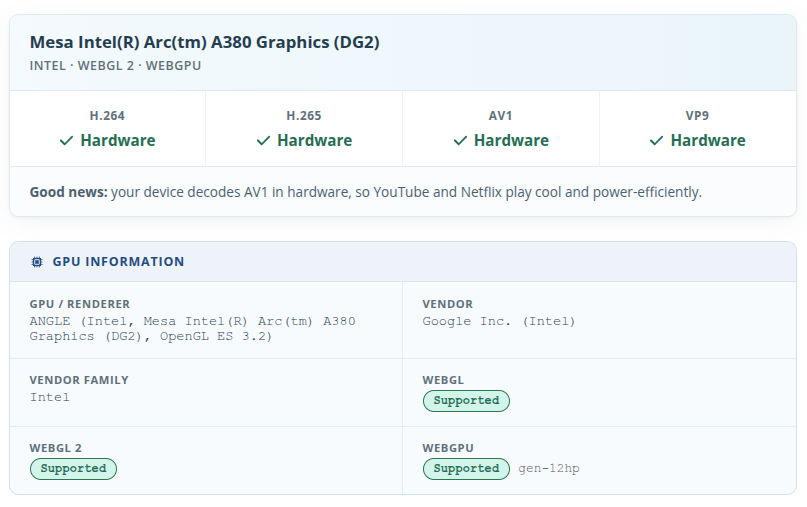
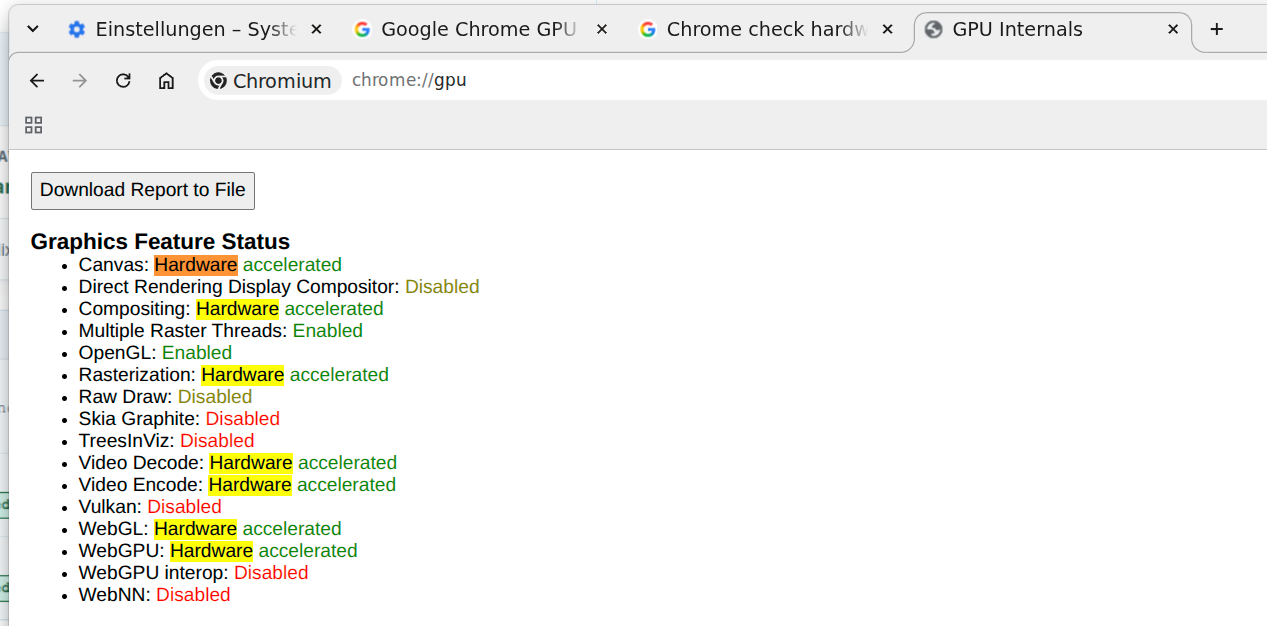
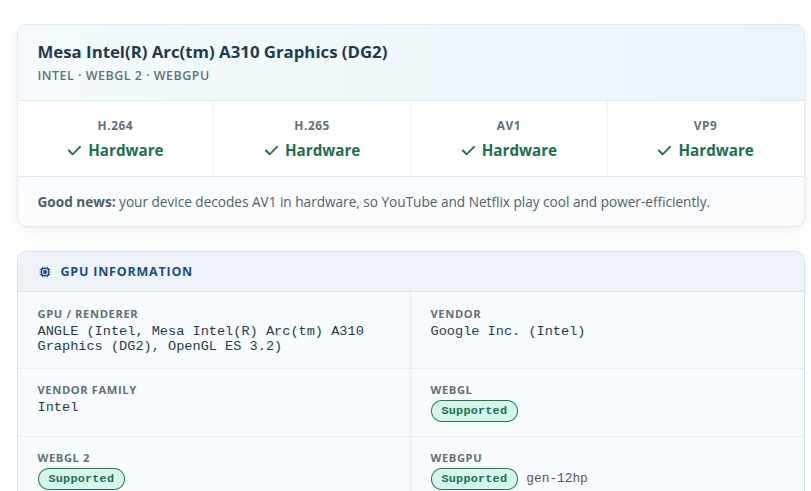
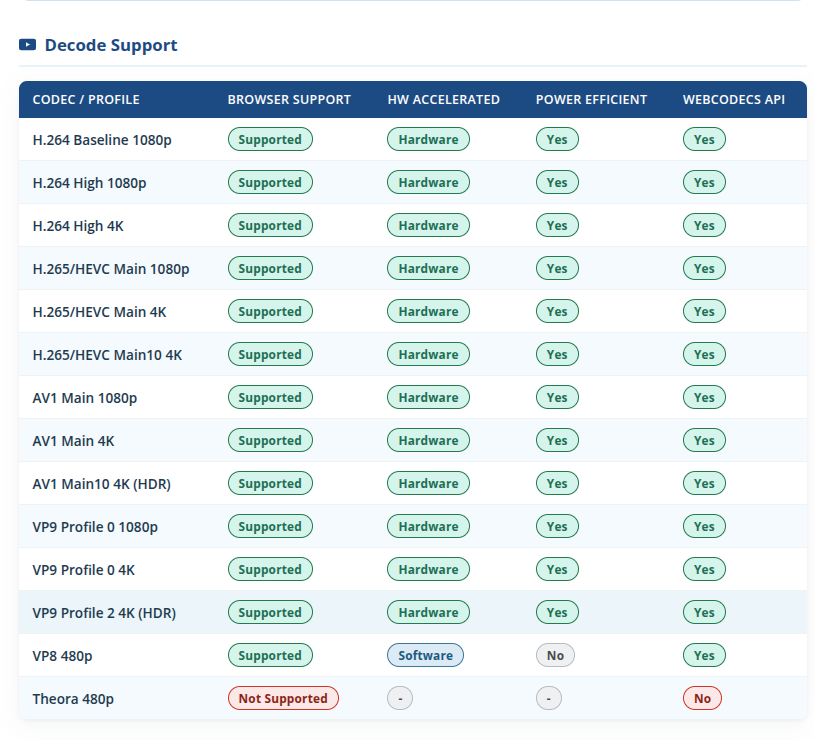
I use the rpm (repo) version of google-chrome. I have my own build of some packages, but it’s using the intel media driver.
This is a development machine, so it has all sorts of stuff installed… but I only use the oss and openh264 repo, which from memory sufficed. I do use the flatpak versions of handbrake and vlc, plus the oss version of mpv.
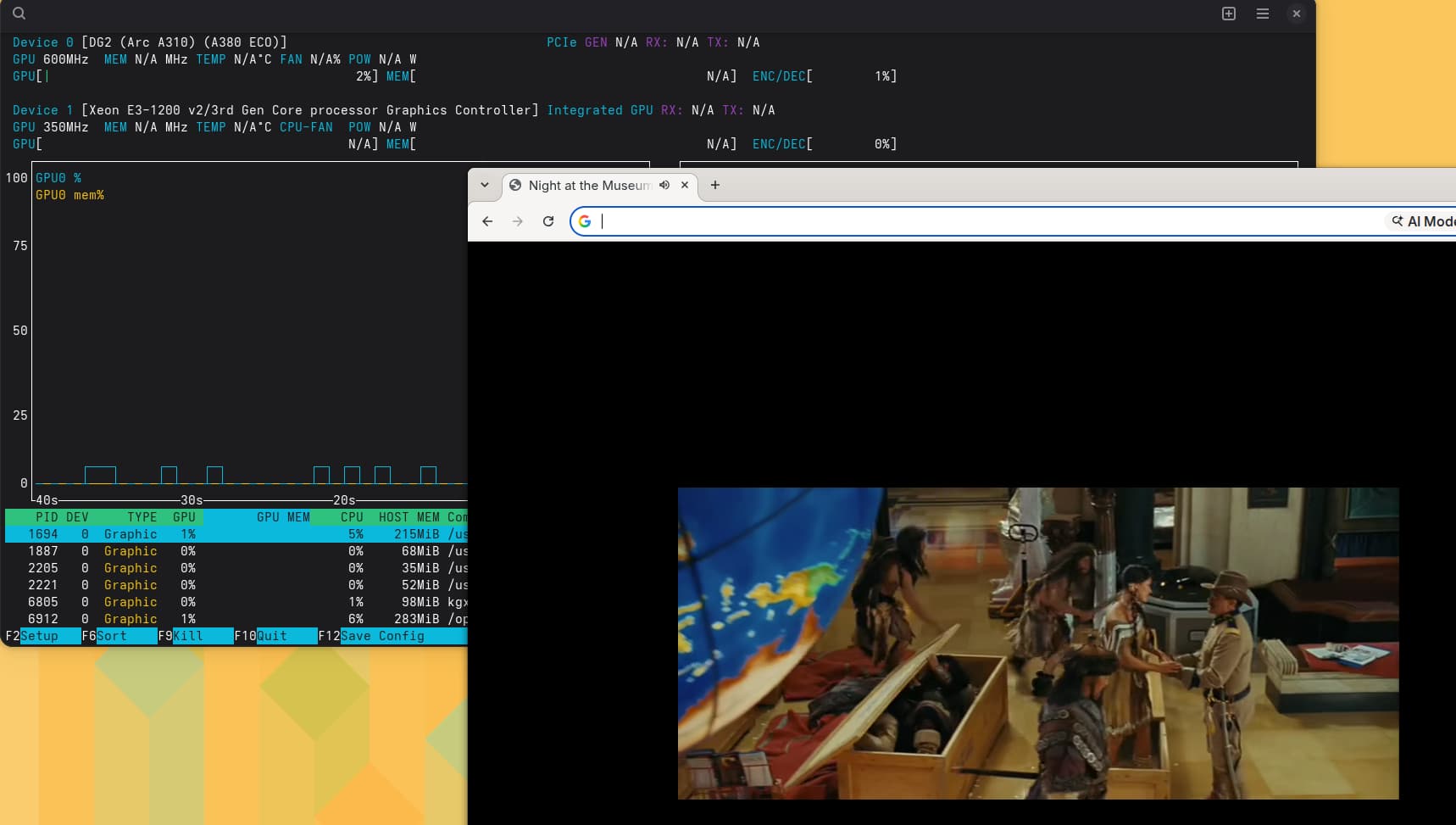
chrome://gpu/ page shows nothing: need to verify it on the codec checker page and with
nvidia-smi dmon
utility whether dec column shows numbers (not zeros) while playing 4K video on Youtube, for example. Trying to use nvidia-vaapi-driver with chromium to enable Hardware acceleration - no luck for now, issue created.